
At the end of October, parliamentary elections will take place in Georgia, deciding whether the country will finally distance itself from the pro-European path based on the rule of law and the protection of human rights or step onto a more autocratic path. This will not be just an ordinary parliamentary election but a battle for the soul of this Caucasian nation. Just a few days after the spring protests in front of the Georgian parliament, I took a Sunday afternoon walk through the center of Tbilisi. The tension of the past days and weeks was palpable, as young protesters demonstrated against the so-called Russian law, which would further subordinate civil society to autocratic authorities. I came to Georgia on a short visit to teach constitutional law and human rights.
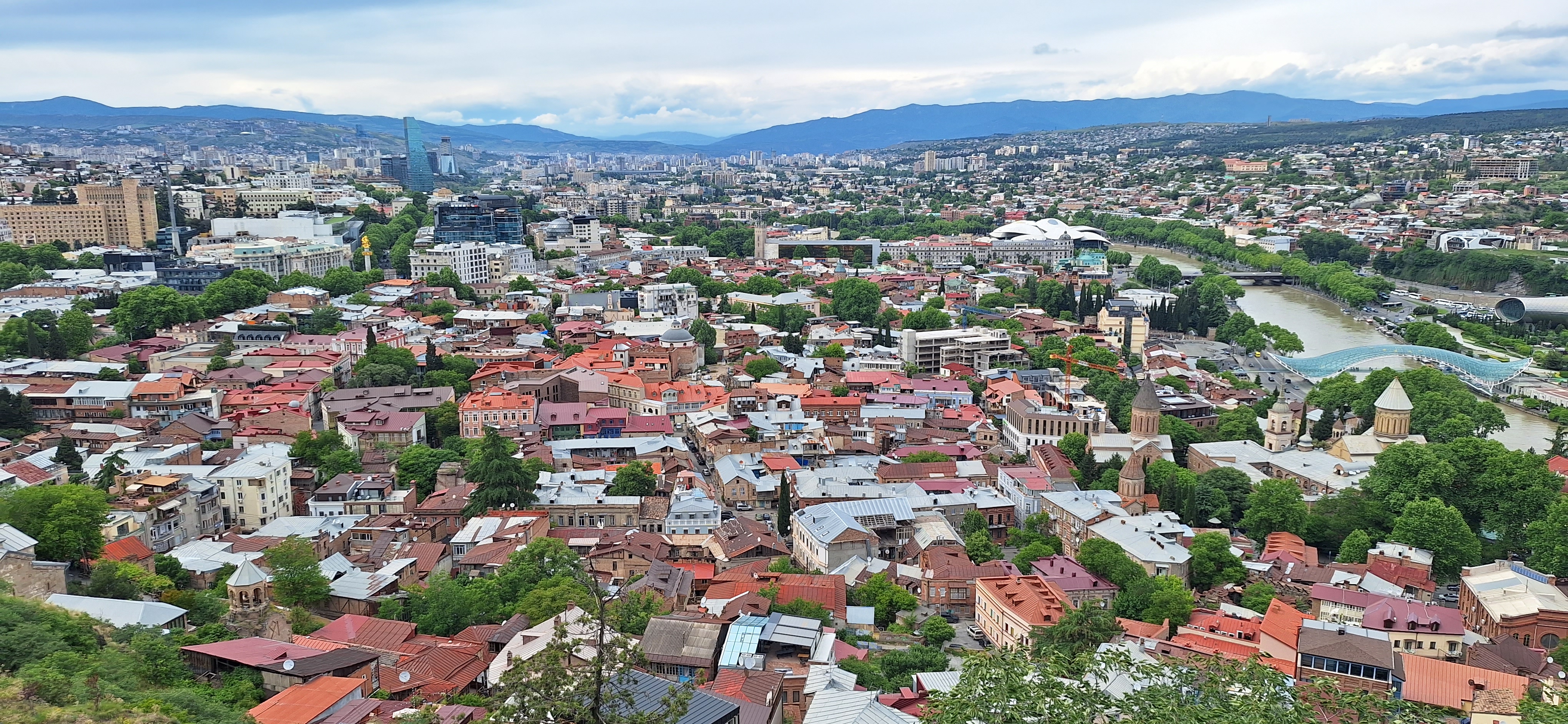
I climbed to the Metekhi Church of the Assumption of the Virgin Mary, from where there is a view of the old part of Tbilisi, the Kura River, Rike Park, and Europe Square. After visiting the church, Beethoven’s Tenth Symphony could be heard from below in Europe Square. Young people, mostly students, gathered to support the rule of law, European integration, and human rights, and against the adoption of the so-called Russian law, which would strengthen state control over civil society organizations. Protests against the current government have become commonplace in Tbilisi during the spring months. They emerged due to the arrogance of state authorities, who, in recent years, have extended their absolute power to all institutions of the Georgian democratic and legal state. They took power following the Russian regime’s example, with the help of financial resources from pro-Russian oligarchs, who, despite the painful wounds from Russia’s colonization of a large part of Georgian territory, mostly profit from cooperation with the Russian economy and ruling authorities.
Compared to neighboring Armenia, Georgia seems more economically developed. The standard of living and the human development index are the highest among the Caucasian countries. The capital, Tbilisi, is a pleasantly laid-back city full of cultural, tangible and intangible heritage, which surprises most visitors from the West. That is why many like-minded people from the Russian Federation seek residence there. The locals are amiable, from professors to ordinary people.
The Influence of Russian Culture and Economy
Russian presence in Georgia is intertwined in various social layers—from the economy and state institutions to culture, religion, sports, and other public areas. Russian investments in the Georgian economy are significant, as is the influence of the Russian Orthodox Church on the Georgian church. Russian investments in the Georgian economy and society have strengthened the Kremlin’s political influence. With the help of loyal oligarchs, Moscow not only maintains its influence in Georgia and the broader Caucasus but also deepens it—from energy to transportation and tourism. Georgian elites, who often see only their short-term pragmatic interests, are therefore in a golden cage, which is becoming even more significant due to Russian colonial interests. Democratic values are not a priority and are trampled upon by authoritarian state practices.
In the center of Tbilisi, you can find several churches that have been restored with the help of Russian donors. Russian can be heard at every step in Tbilisi. I was first addressed in Russian in a café, a hotel, and a fortress. Perhaps the locals think I am Russian, or more likely because Russians are the largest and most visible group of foreigners in Tbilisi; they recognize almost every foreigner as Russian. I respond in a kind of mixture of Slovenian and Russian. The Russian-speaking population has always been present in the city in recent decades, and their number has increased since the Russian Federation’s aggression against Ukraine in February 2022, where opponents of the current political regime have sought refuge. Young Russian families, couples, and groups of friends are encountered everywhere. The Russian language seems to be equal to Georgian in public life. At the same time, the significant Russian presence highlights the conflict between the traditional customs, culture, and traditions of Georgian society and pro-European views that see the country as an essential part of European integration. Georgian business elites, led by oligarchs and tycoons, are intertwined with the Russian elite. In recent decades, their power has also spilt over into politics and Georgian state institutions. This would be problematic in any country, but it is likely even more difficult in a country where a significant part of its territory is under the occupation of Russian authorities.
Of course, not all Russian residents of Georgia support pro-Russian views. Many fled from them and forced mobilization to Georgia, hoping for a life in a democratic and legal state. However, conflicts are reflected in Georgian state institutions, which in recent years have maintained and even strengthened old Soviet functioning patterns—from corruption, conflict of interest, nepotism, and clientelism. The current executive power, which enjoys an absolute majority in the legislative branch, has extended its tentacles into the judiciary and state supervisory institutions. It draws inspiration from autocratic regimes where authorities have strengthened their power through arbitrary measures. The influence of the Russian state and society is so profound that it permeates all aspects of the Georgian state and society, thereby also undermining the fabric of Georgian culture, as it causes conflicts between the Georgian population and the temporary and permanent Russian-speaking residents who often do not share common interests.
Oligarchs, Weak Institutions, the Generation Gap, and the Law of the Ruling
The executive power in Georgia is held by the party “Georgian Dream,” founded by billionaire Bidzina Ivanishvili, who later became Prime Minister. Ivanishvili amassed most of his wealth through wild privatization after the collapse of the Soviet Union. With his financial power, he controls a significant part of the country. The Georgian Dream Party won such a large majority in the last parliamentary elections that it enjoys an absolute majority in the Georgian parliament. The party is supposed to protect traditional Georgian Orthodox values based on the importance of family and religion. In this light, there are also similarities with the current Russian regime, which advocates similar values in Russia. The Georgian Dream, its supporters, members, and loyalists have spread to all branches of Georgian state power in recent years. Educated locals told me during my visit that most of the population no longer trusts the Georgian judiciary to be fair, independent, and impartial.
Conflicts, therefore, are not just ethnic but also arise from the generational gap. While the current government is supported by the population over forty-five years old, the protests against the “Russian law” are led by young people, mainly students. Older generations, who grew up in the former Soviet regime, are closer to the family values pragmatically supported by the current authoritarian government. Younger generations, born after Georgia’s independence, find undemocratic values and governance of the state foreign. They want a peaceful life in a constitutional democracy based on European values.
Youth Revolt Against the “Russian Law”
In the spring, young people had enough. At the end of April and May, they began protesting against the “Russian law” proposal, which would introduce mandatory registration of all legal entities, especially civil society organizations that receive part of their funds from abroad. On this basis, state authorities would label such organizations as foreign agents. Authorities will try to use this law as a tool of pressure and control over civil society, which, in the Russian Federation, for example, led to the suppression and abolition of numerous civil society organizations that pointed out violations of the rule of law and the current autocratic government. At the end of April and May, thousands of people protested every evening against the “Russian law” proposal in front of the Georgian parliament building. Young people who participated in the protests told me they were fighting for their future and did not want to become a Russian colony again. Such statements reflect deep dissatisfaction and fear of an autocratic future, which they see as a direct threat to their freedom. Despite several days of protests and pressure from various European politicians, the parliament passed the law. Later, the President of the Republic of Georgia, despite being elected years ago with the help of the current government, vetoed it. Later, on May 28, the Georgian parliament voted again on adopting the law and confirmed it.
With the implementation of the law, the real problems are just beginning. The centers of power in politics and the economy favor the existing situation. Business elites have been profiting well from indirect trade between the European Union and Russia since the beginning of the attack on Ukraine. Every day, thousands of trucks roll through the Caucasus Mountains passes. Thousands of trucks climb over the Jvari Pass (2395 m) in the Caucasus Mountains daily on the trade route between Russia and Georgia. Since 2022, this route also connects Russia with the EU. However, this will change in 2025/26 when the China Railway Tunnel Group Co. LTD, a Chinese state corporation, completes the tunnel under the Gudauri Mountains between Kvesheti and Kobi. Due to sanctions, traffic has increased significantly in the last two and a half years, as trucks mainly carry goods from the EU to Russia and vice versa.
Before the October Elections
Why would it be necessary to change good practices that allow this elite to live well? Conflicts in public space are not only ethnic and ethical but also pragmatic. Centres of power will not limit themselves and give up their financial privileges. As events in recent months have shown, the centres of power are resolutely fighting against all attempts by pro-European forces to limit their influence. State and business elites, through various means, from law adoption to subsidies, seek to take over state institutions and ultimately consolidate their power. They are ready to silence protests with police, military, and paramilitary forces. They are also prepared to risk losing European and American development aid. The elites do not need this aid, as they have enriched themselves through war trade with both EU member states and Russia.
The European coalition, driven primarily by younger generations, is fighting against the muscular walls of entrenched and established power. Their strength, further reinforced by the Orthodox religious community, can only be limited through coordinated action by all pro-European forces. The October elections will, therefore, be decisive for the socio-economic development and the rule of law in Georgia and the broader Caucasus region. Georgians will be choosing in these elections not only between the pro-European and pro-Russian blocs but also whether they wish to see even more profound Russian influence, potentially turning the country into a Russian colony. Although a deadlock is currently expected between the pro-European and pro-Russian blocs, even in a victory by pro-European forces, it will take years to establish strong institutions committed to upholding the rule of law and protecting constitutional democracy. However, if the pro-Russian coalition wins, there will likely be an exodus of younger generations who do not wish to live in an increasingly autocratic state. At the same time, the international community, particularly the European Union, will be forced to reconsider and possibly reduce its support for various social and economic projects in Georgia, following the example of the United States.
The author of the article and photographs is Jernej Letnar Černič. This portal first published this article in Slovenian on 18 August 2024.
 Esohap